How to Create a Homeschool Schedule That Actually Works
By Nick & Amanda | Updated September 2026
One of the first things new homeschool families ask us is some version of the same question: “How do you structure your day?”
It’s a fair question. When you pull your kids out of a system that has scheduled every minute of every day for years, the blank slate of homeschooling can feel overwhelming. What do you do first? How long should each subject take? Do you need to follow a strict schedule?
Before building your schedule make sure you know what you’re working toward. Read our complete guide: How to Create a Homeschool Mission Statement →
For the best planner to organize your schedule — read our complete guide: Best Homeschool Planners →
After 13 years of homeschooling three kids through elementary, middle, and high school we’ve tried just about every scheduling approach imaginable. Here’s what we’ve learned.
Homeschool Schedule — Quick Reference:
| Age | Daily Hours | Schedule Type |
|---|---|---|
| Kindergarten | 1-2 hours | Time-based — predictability helps |
| Grades 1-3 | 2-3 hours | Time-based or task-based |
| Grades 4-6 | 3-4 hours | Task-based or loop |
| Grades 7-8 | 4-5 hours | Task-based — growing independence |
| Grades 9-12 | 5-6 hours | Task-based — mostly independent |
| Daily subjects | Math, Reading, Writing | Every day without exception |
| 3-4x per week | History, Science, Spelling | Rotate through loop |
| 1-2x per week | Art, Music, PE, Nature Study | Loop or as desired |
| Best tip | Start later than you think | 9-9:30am beats 8am for most families |
| Our system | Hybrid — time-based core + loop electives | 13 years — still evolving |
The Most Important Thing to Know About Homeschool Schedules
Before we get into the how, let’s establish the most important truth about homeschool scheduling:
Your homeschool schedule should serve your family — not the other way around.
The biggest mistake new homeschool families make is trying to recreate a school day at home. Desk at 8am. Subject every 45 minutes. Lunch at noon. Dismissal at 3pm.
That model exists because public schools need to manage 25 kids in one room with one teacher. You don’t have that problem. You have one teacher and a handful of students who you know better than any teacher ever will.
The most effective homeschool schedules look nothing like a school day. They’re shorter, more flexible, and built around how your specific child learns best.
How Much Time Do You Actually Need?
This surprises most new homeschool families: you don’t need 6-7 hours of instruction per day.
One-on-one instruction is dramatically more efficient than classroom instruction. Without transitions between classes, waiting for other students, interruptions, and administrative time a homeschool family can cover the same material as a traditional school in 2-4 hours per day for elementary students and 3-5 hours for middle and high school students.
Here’s a realistic time estimate by age:
| Age | Typical Daily Instruction Time |
|---|---|
| Kindergarten | 1-2 hours |
| Grades 1-3 | 2-3 hours |
| Grades 4-6 | 3-4 hours |
| Grades 7-8 | 4-5 hours |
| Grades 9-12 | 5-6 hours |
These are guidelines — not rules. Some days you’ll do more. Some days less. The beauty of homeschooling is that when your child masters a concept you move on. You don’t wait for the rest of the class.
The Three Types of Homeschool Schedules
Before building your schedule you need to decide which type of schedule fits your family best. There are three main approaches:
Type 1 — Time-Based Schedule
You assign specific times to each subject. Reading from 8-9am. Math from 9-10am. And so on.
Best for: Families who thrive with structure. Kids who do better knowing exactly what’s coming next. Families with young children who need predictability.
Drawback: Inflexible. If math takes longer than expected everything gets pushed back.
Type 2 — Task-Based Schedule
Instead of times you create a daily checklist of tasks to complete. No time pressure — just work through the list.
Best for: Older students who can work more independently. Families with varying daily schedules. Kids who get anxious with strict time limits.
Drawback: Some kids will drag their feet without time boundaries.
Type 3 — Loop Schedule
Instead of doing every subject every day you rotate through subjects in a loop. Day 1: Math, Reading, History. Day 2: Math, Reading, Science. Day 3: Math, Reading, Art. The loop repeats regardless of where you stopped.
Loop scheduling is especially powerful for families with multiple children at different grade levels. Read our complete guide: How to Homeschool Multiple Ages at Once →
Best for: Families with multiple children at different levels. Families who want variety without planning. Any subject that doesn’t need to be done daily.
Drawback: Takes some getting used to. Progress in any one subject is slower since you’re not doing it daily.
Our family has used all three approaches at different stages. Right now with middle and high schoolers we use a hybrid — time-based for core subjects and a loop schedule for electives and enrichment subjects.
How to Build Your Homeschool Schedule — Step by Step
Step 1 — List your subjects
Write down every subject you plan to teach. Be realistic — don’t list 15 subjects if you know you’ll only consistently do 8.
Core subjects most families include:
- Math
- Reading and Language Arts — phonics, writing, grammar, literature
- History
- Science
- Handwriting — for younger students
- Spelling
- Foreign Language — if applicable
Enrichment subjects:
- Art
- Music
- Physical Education
- Nature Study
- Life Skills
Step 2 — Decide which subjects need to happen daily
Not everything needs to happen every day. Here’s a simple framework:
Daily: Math, Reading, Writing or Language Arts 3-4 times per week: Spelling, History, Science, Handwriting 1-2 times per week: Art, Music, PE, Nature Study, Life Skills
This immediately makes your schedule more manageable. You’re not trying to squeeze everything into every day.
Step 3 — Schedule your hardest subjects first
Whatever requires the most focused attention — usually Math and Language Arts — schedule first when your child’s brain is freshest. Save lighter subjects for afternoon.
Most homeschool families find that mornings are gold. Start school shortly after breakfast while energy is high and save afternoons for independent reading, outdoor time, and activities.
Step 4 — Build in margin
Every schedule needs breathing room. If you plan 4 hours of instruction per day don’t fill all 4 hours. Plan 3 hours and let the extra hour absorb the unexpected — the science experiment that takes longer than planned, the math concept that needs more time, the deep conversation that happens in the middle of history.
Homeschooling at its best is full of those unplanned moments. A schedule that has no room for them will stress you out constantly.
Step 5 — Try it for two weeks — then adjust
Don’t expect your first schedule to be perfect. Build something reasonable, try it for two full weeks, then evaluate honestly. What’s working? What isn’t? Adjust and try again.
The perfect homeschool schedule is the one your family will actually follow — not the most elaborate one you can design.
Sample Homeschool Schedules by Age
Elementary Schedule — Grades 1-3 (approximately 2.5 hours)
| Time | Subject |
|---|---|
| 8:30am | Morning Basket — read-aloud, memory work, devotions |
| 9:00am | Math |
| 9:30am | Phonics or Reading |
| 10:00am | Break — snack and outside time |
| 10:20am | Writing or Handwriting |
| 10:40am | History or Science — alternate days |
| 11:10am | Free choice — art, puzzles, independent reading |
| 11:30am | Done |
Middle School Schedule — Grades 6-8 (approximately 4 hours)
| Time | Subject |
|---|---|
| 8:30am | Math |
| 9:15am | Language Arts — writing, grammar, literature |
| 10:00am | Break |
| 10:15am | History |
| 11:00am | Science |
| 11:45am | Lunch |
| 1:00pm | Electives — foreign language, art, music |
| 2:00pm | Independent reading |
| 2:30pm | Done |
High School Schedule — Grades 9-12 (approximately 5 hours)
| Time | Subject |
|---|---|
| 8:30am | Math |
| 9:30am | English — literature, composition, grammar |
| 10:30am | Break |
| 10:45am | Science — with lab work 2x per week |
| 11:45am | Lunch |
| 1:00pm | History |
| 2:00pm | Electives — foreign language, fine arts, elective courses |
| 3:00pm | Independent study and reading |
| 4:00pm | Done |
These are starting points — not blueprints. Every family looks different.
Have multiple children at different grade levels? Read our complete guide to managing multiple ages simultaneously: How to Homeschool Multiple Ages at Once →
Scheduling Tips From 13 Years of Experience
Start later than you think you need to. Most homeschool families try to start school too early. If your kids are slow starters give them time to wake up, eat breakfast, and transition. A 9am or even 9:30am start often produces better results than forcing school at 8am.
Use a Morning Basket. A Morning Basket is a collection of gentle subjects done together as a family first thing — read-alouds, memory work, poetry, devotions, nature journals. It eases everyone into the school day and builds family connection. We’ve used a Morning Basket for years and it’s one of our favorite parts of our homeschool day.
Protect your Math time. Whatever else gets flexible, protect your math time. Math is cumulative — skipping or rushing it creates gaps that compound over time. Do math every day, at your child’s best time of day, with full focus.
Build in a weekly reset day. One day per week — usually Friday for most families — keep the schedule lighter. Use it for catch-up, field trips, co-op, or just free exploration. This gives everyone a breath and prevents burnout.
Don’t compare your schedule to anyone else’s. The homeschool community is wonderful but it can also make you feel like you’re never doing enough. Some families school year-round. Some do four day weeks. Some do intensive unit studies. Some follow a rigid classical curriculum. None of these approaches is universally right — the right schedule is the one that works for your family and your children.
When Your Schedule Isn’t Working
Every homeschool family hits seasons where the schedule falls apart. Life happens. Kids go through difficult phases. Parents get overwhelmed.
When your schedule isn’t working resist the urge to add more structure. Usually the problem is the opposite — the schedule is too rigid, too ambitious, or not built around how your specific children actually learn.
Ask yourself:
- Is this schedule realistic for where my kids actually are right now?
- Am I trying to do too much?
- Does this schedule account for my family’s energy patterns?
- Are there subjects I’m including out of guilt rather than genuine educational value?
Strip it back. Start simpler. Build back up from there.
Planning Your Homeschool Year?
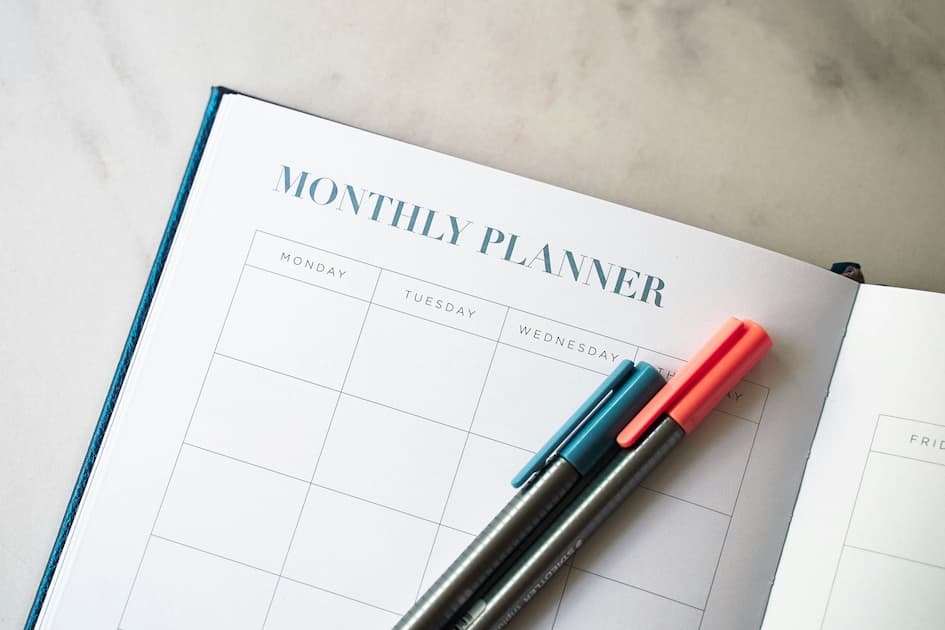
The Boldly Educated Homeschool Planner 2026-2027 is designed for families just like yours — 12 monthly calendars, weekly lesson plan templates, attendance tracking, grade recording, and a complete high school planning section. 58 pages, instant PDF download.
Frequently Asked Questions About Homeschool Schedules
Do I have to school Monday through Friday?
No — and many families don’t. Four-day school weeks are extremely popular in the homeschool community — keeping Friday for field trips, co-op, catch-up, or simply rest. Year-round homeschooling with shorter breaks is another popular alternative to the traditional September-June calendar. Some families school intensively for six weeks then take one week off throughout the year. The schedule that works is the one your family will sustain — not the one that most closely resembles traditional school.
What time should we start school?
Whatever time your family functions best — and it’s probably later than you think. Most homeschool families who start at 8am find themselves fighting groggy, resistant children for the first hour. Families who start at 9 or 9:30am consistently report smoother mornings and more productive school sessions. Night owl families sometimes school in the afternoon and evening. Try different start times for two weeks each and let the results tell you what works.
How do I prevent my child from dragging school out all day?
The most effective tool is a clear end time rather than a clear start time. Tell your child school ends at noon — or whenever — and everything on the checklist needs to be done by then. Children who understand that efficiency leads to more free time become surprisingly motivated to focus. Dawdling during school time loses free time afterward — a natural consequence that’s more motivating than most imposed consequences.
What do I do when we fall behind our schedule?
Let some things go and protect others. If you fall behind in history for a week — it’s fine, history will keep. If you fall behind in math for a week — address it immediately because math gaps compound. Triage your subjects honestly: what is foundational and must be maintained, and what can flex without real consequence? Most families find that protecting math and reading consistently while letting other subjects flex handles most schedule disruptions without lasting harm.
How do I schedule for a child who hates sitting still?
Stop scheduling sitting. A child who hates sitting still learns better through movement — math facts practiced while jumping on a trampoline, history narrated while drawing, spelling words practiced while shooting hoops. Build movement into your schedule as an educational delivery method rather than a break from education. The schedule should follow the child — not force the child to follow the schedule.
Your Next Step
The best homeschool schedule is one you’ll actually use. Start simple, stay flexible, and give yourself grace to adjust as you learn what works for your family.
Need a planner to keep your schedule organized? Read our complete guide:
Best Homeschool Planners →
If you’re just getting started head to our Start Here page for a complete guide to launching your homeschool with confidence.
And don’t forget to grab our free First Year Homeschool Checklist below — everything you need to get started in one simple download.