Homeschool Socialization: The Truth From a 13-Year Homeschool Family
By Nick & Amanda | Updated September 2026
If you’ve told anyone you’re considering homeschooling you’ve already heard it.
“But what about socialization?”
It’s the first objection. The most persistent objection. The one that makes homeschool families roll their eyes because they’ve answered it so many times.
After 13 years of homeschooling three kids we have a lot to say about homeschool socialization. Not the defensive answer. Not the dismissive answer. The honest answer.
Homeschool Socialization — Quick Reference:
| Concern | Honest Answer |
|---|---|
| Do homeschoolers have friends? | Yes — through co-ops, sports, church, community activities |
| Is homeschool socialization inferior? | Research says no — often superior in social maturity measures |
| What replaces school peer interaction? | Co-ops, sports leagues, community activities, multi-age interaction |
| Can homeschoolers play public school sports? | Yes — in many states via Tim Tebow laws |
| Does homeschooling cause social problems? | Only when families homeschool in isolation — intentionality matters |
| What’s the biggest socialization mistake? | Treating socialization as automatic rather than intentional |
| Our experience | ✅ 13 years — 3 kids — socially thriving — no regrets |
Where the Concern Comes From
The socialization concern is legitimate — at its core. Children need to develop social skills, build friendships, learn to navigate conflict, and experience community beyond their immediate family. School provides a structure for that to happen automatically.
When you remove your child from that structure the question naturally arises: where does socialization come from now?
It’s a fair question. The problem is the assumption buried inside it — that the socialization children receive in traditional school is inherently good, complete, and superior to what homeschool families can provide.
That assumption deserves examination.
What School Socialization Actually Looks Like
Think about what socialization in a traditional school actually involves:
- Spending 6-7 hours per day primarily with children born within 12 months of you
- Navigating a highly structured institutional environment with limited autonomy
- Learning social skills within a setting designed for crowd management
- Experiencing peer pressure, social hierarchies, and clique dynamics
- Limited interaction with adults beyond authority figures
- Minimal meaningful interaction with younger or older children
This is not an argument against school socialization. It’s an honest description of what it actually is.
School socialization produces children who are skilled at navigating peer relationships within an institutional setting. That’s genuinely valuable. But it’s not the complete picture of human social experience.
What Homeschool Socialization Actually Looks Like
Homeschool socialization looks different — and in many ways richer — than most people assume.
After 13 years here’s what socialization has looked like for our family:
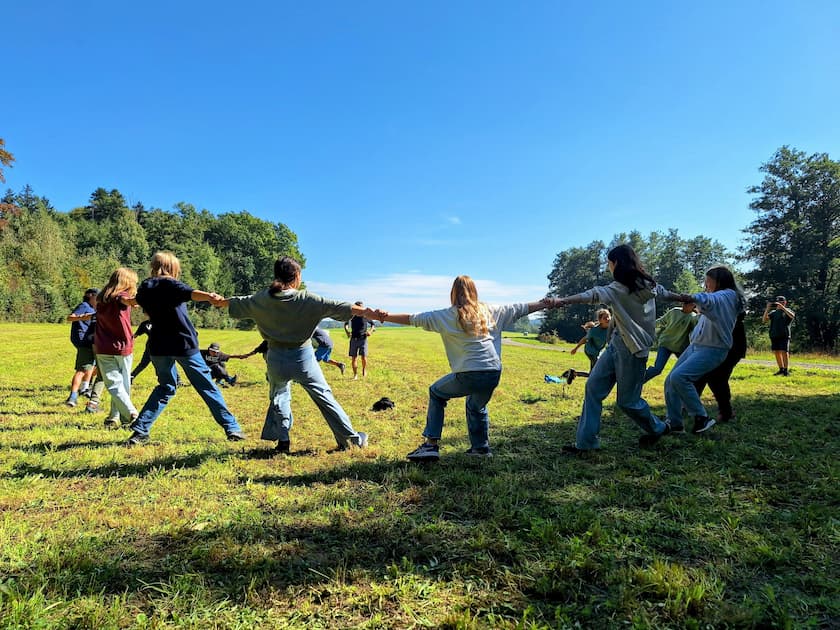
Homeschool Co-ops We’ve participated in homeschool co-ops throughout our journey. Co-ops bring together multiple homeschool families for shared classes, projects, and activities. Our kids have taken classes taught by other parents, collaborated on science projects, performed in plays, and built genuine friendships with kids from a range of ages and backgrounds.
Sports and Athletics Our kids have participated in community sports leagues, church athletics, and — in states with Tim Tebow laws — public school sports. Athletics provide exactly the kind of team-oriented social experience that concerns people about homeschooling. Check our state law guides to see if your state guarantees homeschool sports access.
Community Activities 4-H, Scouts, youth group, community theater, music ensembles, art classes, martial arts, dance — homeschool families access all of these. Our kids have participated in activities with publicly schooled kids, privately schooled kids, and other homeschooled kids. The diversity of their social world has been genuine.
Part-Time Jobs and Volunteering Older homeschool students have significant time for part-time work and community service. These experiences provide social development that no school program can replicate — real relationships with adults, real responsibility, real consequences for performance.
Multi-Age Interaction This is one of the most underappreciated aspects of homeschool socialization. Our kids interact comfortably with people of all ages — toddlers, teenagers, young adults, middle-aged adults, elderly people. They’re not confined to the narrow social world of same-age peers. That multi-age comfort and competence is a genuine social advantage.
Family Relationships Homeschooling strengthens family bonds in ways that are difficult to quantify but easy to observe. Our kids actually like each other. They spend real time together, collaborate on projects, and have developed genuine sibling friendships. That’s not nothing.
The Research on Homeschool Socialization
The research on homeschool socialization is consistently positive — and consistently ignored by people who raise the socialization objection.
Studies have found that homeschooled students:
- Score higher on measures of social maturity than traditionally schooled peers
- Demonstrate higher levels of civic engagement as adults
- Show lower rates of behavioral problems
- Are more likely to participate in community service
- Report higher levels of life satisfaction as adults
A 2003 study by Dr. Richard Medlin found that homeschooled children had significantly better social skills and fewer behavioral problems than children attending conventional schools.
This doesn’t mean homeschooling automatically produces socially thriving children. It means that well-implemented homeschooling — with intentional community involvement — produces excellent social outcomes.
When Homeschool Socialization Goes Wrong
Honesty requires acknowledging this: homeschool socialization can go wrong. We’ve seen it.
Families who homeschool in isolation — never participating in co-ops, sports, community activities, or regular peer interaction — can produce children who struggle socially. This is real and it happens.
The difference between homeschool socialization done well and done poorly is intentionality. Public school socializes your child automatically — it happens whether you think about it or not. Homeschool socialization requires deliberate effort. You have to build the community. You have to seek out the activities. You have to create the opportunities.
Families who treat socialization as important and pursue it actively raise socially thriving homeschool kids. Families who don’t — don’t.
How to Build Strong Homeschool Socialization
If you’re concerned about socialization — or want to be intentional about it — here’s what we’ve found works:
Join a homeschool co-op This is the single most impactful thing you can do for homeschool socialization. A good co-op provides regular peer interaction, shared learning experiences, and community for both children and parents. We’ve written a complete guide to finding the right co-op for your family: How to Find a Homeschool Co-op →
Need ideas for what your co-op can actually do together? Read our complete guide: Homeschool Co-op Ideas →
One of the most popular structured community options for homeschoolers is Classical Conversations — which provides weekly community days with trained tutors alongside your home instruction. Read our complete review: Classical Conversations Review →
Enroll in community activities Sports, music, art, theater, martial arts, 4-H, Scouts — pick activities your child genuinely enjoys and commit to them consistently. Consistent participation builds real friendships over time. Sporadic participation doesn’t.
Pursue team sports specifically Team sports provide exactly the social dynamics people worry homeschoolers miss — working toward a shared goal, navigating conflict within a group, winning and losing together. If your state has a Tim Tebow law your child can participate in public school sports. If not community leagues are widely available.
Connect with your local homeschool community Most areas have active homeschool communities with regular gatherings, field trips, and events. Connect with other homeschool families — both for your children’s socialization and for your own support as a homeschool parent.
Don’t over-schedule The solution to socialization concerns is not to fill every hour with structured activity. Children need unstructured time — neighborhood play, free exploration, downtime — as much as they need organized activities. Over-scheduled homeschool kids are stressed homeschool kids.
Let your child lead Pay attention to what your child naturally gravitates toward socially. Some kids thrive in large group settings. Others do better with one or two close friends. Some love team sports. Others prefer individual pursuits with shared community elements like music or art. Follow your child’s genuine social nature rather than forcing a model that doesn’t fit.
What Our Kids Have to Say
Our kids have been asked the socialization question too — by well-meaning relatives, curious neighbors, and skeptical strangers. Here’s what they’ve consistently said:
They have friends. Good ones. Friends from co-op, from sports, from church, from the neighborhood. Friends who are homeschooled and friends who go to public school. They don’t feel isolated. They don’t feel like they’re missing out.
What they do feel — and what they consistently express — is gratitude for the depth of their education and the flexibility of their lives. They’ve had experiences and opportunities that their publicly schooled friends simply haven’t had.
That’s not a criticism of public school. It’s a description of what well-implemented homeschooling actually looks like from the inside.
Frequently Asked Questions About Homeschool Socialization
Will my homeschooled child have friends?
Yes — but you have to be intentional about it. Homeschool socialization doesn’t happen automatically the way school socialization does. The most effective path to genuine friendships for homeschooled children is a homeschool co-op — a regular gathering of homeschool families for shared classes, projects, and activities. Children who attend co-op consistently build real friendships over time. Sports leagues, church youth groups, community activities, and neighborhood play all contribute as well. Read our complete guide: How to Find a Homeschool Co-op →
At what age does homeschool socialization become more important?
Socialization matters at every age — but the nature of what children need changes. Young children (ages 4-8) benefit most from consistent play with a small group of familiar children — a co-op provides this naturally. Middle school age children (ages 9-13) increasingly need peer relationships and the experience of navigating social dynamics within a group — team sports, theater, and co-op classes become particularly important at this stage. High school age students benefit enormously from community involvement, part-time work, dual enrollment classes, and activities that connect them with a broad range of people beyond their immediate family.
Do homeschooled kids struggle socially as adults?
The research says no — in fact multiple studies find that homeschooled adults demonstrate higher civic engagement, stronger community involvement, and greater life satisfaction than their traditionally schooled peers. Anecdotally families who homeschool with intentional community involvement consistently raise socially thriving adults. The key variable is intentionality — families who actively build social opportunities for their children raise socially confident adults. Families who homeschool in isolation risk genuine social difficulties.
How do I handle the socialization question from skeptical family members?
The most effective response is honest and specific rather than defensive. Share what your homeschool socialization actually looks like — the co-op your children attend, the sports they play, the community activities they’re involved in, the friendships they’ve built. Specific concrete details are far more convincing than abstract arguments. If you’re just starting out and don’t yet have those specifics in place — that’s your signal to prioritize building community before skeptical relatives ask again.
What if my child is introverted — does homeschooling make it worse?
Homeschooling can actually be a gift for introverted children. Traditional school’s constant social demands — crowded classrooms, mandatory group work, shared spaces all day — are genuinely exhausting for introverted children in ways that affect their learning. Homeschooling allows introverted children to do their best learning in a quieter environment while choosing social activities that genuinely suit their temperament — a small co-op rather than a large school, one-on-one friendships rather than group dynamics, activities that align with their actual interests. Introversion is not a social deficiency — it’s a temperament that homeschooling can genuinely accommodate better than traditional school.
The Bottom Line on Homeschool Socialization
The socialization question deserves a real answer — not dismissal and not defensiveness.
Here it is: homeschool socialization is real, rich, and in many ways superior to what traditional school provides — when parents are intentional about building community and seeking social opportunities for their children.
The families who ask the socialization question with genuine concern deserve this honest answer. And the families who ask it as a gotcha deserve it too.
Thirteen years in our kids are proof that homeschool socialization works. Yours can be too.
Ready to start homeschooling? Browse our complete curriculum reviews to find the right fit for your family: Curriculum Reviews →
Head to our Start Here page for everything you need to launch your homeschool with confidence.
And grab our free First Year Homeschool Checklist below — everything you need to get started in one simple download.